Updated October 28, 2026 · 9 min read
We earn a commission when you buy through our links, at no extra cost to you. How this works.
Short on time?
 Reviewed hereGarmin Forerunner 2654.7★ · 3,100+ ratings on AmazonCheck price on Amazon →
4.7★ · 3,100+ ratings
Garmin Forerunner 265: the training watch most runners grow into
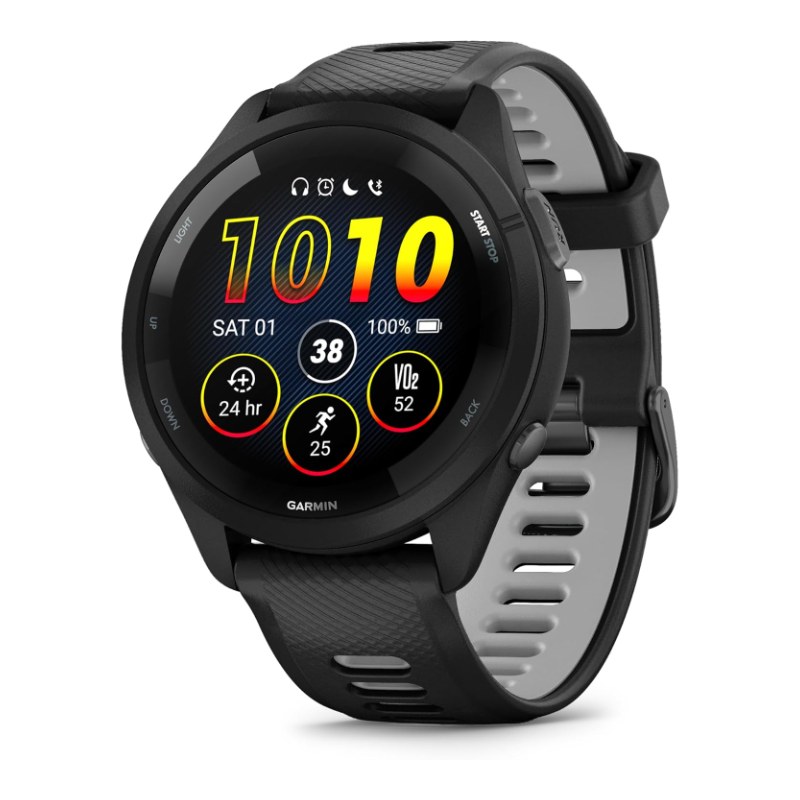
The Garmin Forerunner 265 is a GPS running watch with a bright AMOLED touchscreen, real buttons and Garmin’s full training toolkit: training readiness, HRV status, training load and race-day predictions. It holds a 4.7-star rating from more than 3,100 Amazon buyers.
Below: what buyers say, who really needs the 265 over the cheaper Forerunner 165, battery life in real use, and the best settings for new owners.
The short answer
Our verdict: the best mid-price running watch for runners training for a race. It gives you the coaching data of far more expensive Garmins in a light, comfortable watch with a gorgeous screen.
If you just want pace, distance and heart rate, the Forerunner 165 or 55 saves money.
Buy it if
- You train for 5K to marathon races and want guidance on when to push or rest.
- You want a bright AMOLED screen with real buttons for sweaty or gloved hands.
- You care about sleep, HRV and recovery data, not just pace.
- You want music on your wrist (Music version).
Skip it if
- You only run casually and want basic stats.
- You need multi-week battery life; the 55 lasts longer.
- You want maps and navigation; that is the 965 territory.
What you get
The 265 comes in two sizes: the standard 46 mm and the smaller 265S (42 mm) for slimmer wrists, with slightly different battery life. Both have the same features. Check the listing for colors and the current price; Garmin watches are often discounted around Black Friday and Prime Day.
Key specs
| Spec | Forerunner 265 |
|---|---|
| Display | 1.3 in AMOLED touchscreen plus 5 buttons |
| Battery (smartwatch) | Up to 13 days |
| Battery (GPS) | Up to 20 hours |
| GPS | Multi-band GPS with SatIQ |
| Training tools | Training readiness, HRV status, training load, race predictor, daily suggested workouts |
| Sports profiles | 30+ (run, bike, swim, triathlon and more) |
| Music | Music storage on the Music version |
| Payments | Garmin Pay |
What 3,100+ buyers say: the box score
Amazon groups review mentions by topic. Here is the Forerunner 265 box score as of October 2026.
| TOPIC | WHAT BUYERS SAY | MENTIONS |
|---|---|---|
| Look | Attractive, bright screen | 382 |
| Function | Does everything runners need | 169 |
| Battery | Long battery life | 134 |
| Sleep | Useful sleep tracking | 117 |
| Value | Worth the money | 110 |
| Features | Lots of useful features | 73 |
| Accuracy | Accurate GPS and data | 64 |
| Interface | Mixed: menus take learning | 82 |
The takeaway: buyers love the screen, battery and training data. The one mixed topic is the interface: Garmin menus are deep, and new users say it takes a week or two to set the watch up the way they like.
What is training readiness?
Training readiness is a score from 1 to 100 that the 265 shows each morning. It combines your sleep, recovery time, training load, HRV status and stress. A high score says you are ready for a hard session; a low one suggests an easy run or rest day. For runners who tend to overtrain, this is the feature that justifies the 265 over cheaper watches.
HRV status tracks your heart rate variability overnight. After a few weeks it learns your normal range and flags when you are run down, stressed or getting ill. Combined with the morning report, it gives you a quick, honest read on how your body is coping.
Daily suggested workouts and race tools
Tell the 265 your goal race and date, and it builds day-by-day suggested workouts: easy runs, tempo runs, intervals and long runs, adjusted to your readiness. The race widget counts down to race day and predicts your finish time. Garmin Coach plans are also available free in the Garmin Connect app.
Battery life in real use
Garmin lists up to 13 days as a smartwatch and up to 20 hours of GPS. In practice, runners who train five or six hours a week with the always-on display off usually charge about once a week. Turning on always-on display, multi-band GPS for every run and music playback cuts that a lot. For marathon training it is plenty; for ultra races, look at bigger Garmins.
Forerunner 265 vs 165
The Forerunner 165 has the same AMOLED style and many of the same basics, and it is our top pick in best GPS running watches under $300. The 265 adds training readiness, training load and training effect, multi-band GPS accuracy, and triathlon features. If you race and follow structured training, the 265 is worth the extra. If you mostly run for fitness, the 165 is the smarter buy; see our Forerunner 165 review.
Forerunner 265 vs the rivals
Forerunner 265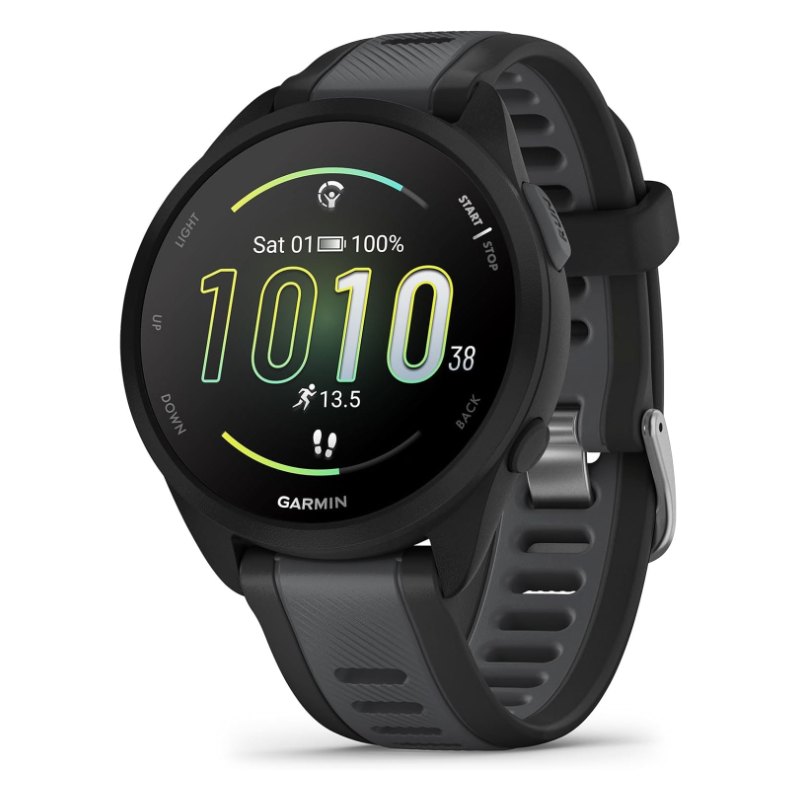 Forerunner 165
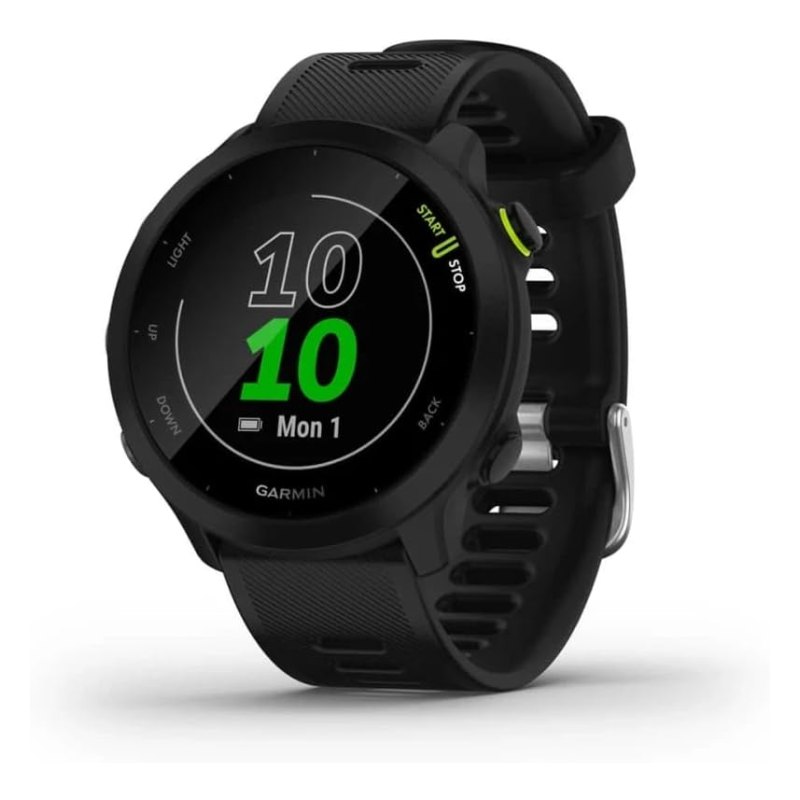 Forerunner 55
| Forerunner 265 | Forerunner 165 | Forerunner 55 | |
|---|---|---|---|
| Screen | AMOLED | AMOLED | Memory-in-pixel |
| Training readiness | Yes | No | No |
| Multi-band GPS | Yes | No | No |
| Battery (smartwatch) | Up to 13 days | Up to 11 days | Up to 2 weeks |
| Best for | Race training | Most runners | Budget, long battery |
All three are excellent. The 55 is the budget pick with the longest battery, the 165 is the best value with a modern screen, and the 265 is for runners who want coaching data and better GPS in cities and under trees.
Pros and cons
Pros
- Bright, sharp AMOLED screen that is easy to read on runs
- Training readiness and HRV status give real coaching insight
- Light and comfortable for all-day wear and sleep
- Accurate multi-band GPS
- Buttons work with sweaty or gloved hands
Cons
- Costs more than the very capable Forerunner 165
- Garmin menus take time to learn
- No maps or turn-by-turn navigation
- Battery drops fast with always-on display
Is the Garmin Forerunner 265 worth it?
Yes, if you train with goals. The 265 is the cheapest Garmin with the full set of training readiness and load tools, and those features genuinely help runners avoid overtraining and arrive at races fresh. The screen is a joy to use, and buyers rate it highly for comfort and battery. If you do not need that data, the Forerunner 165 gives you 80 percent of the experience for less.
Best settings for new owners
- Turn off always-on display to roughly double battery life.
- Use “All + Multi-Band” GPS only for races or tricky routes; standard GPS is fine for daily runs.
- Wear it to sleep for at least three weeks so HRV status can establish your baseline.
- Add your goal race in Garmin Connect to unlock suggested workouts and the race widget.
- Set heart rate zones from a recent hard effort rather than relying only on age.
Who it suits best
The 265 is ideal for runners training for half marathons and marathons, triathletes on a budget, and anyone who wants science-based guidance without a coach. It is also a good upgrade for owners of older Forerunners like the 45 or 55 who want a modern screen. Casual joggers and walkers will be happier with a cheaper watch.
Is it a good gift?
For a runner with a race on the calendar, it is one of the best gifts you can give. It looks premium, works with iPhone and Android, and comes with everything needed to start. See our gifts for runners for more ideas.
Our final word
The Forerunner 265 hits the sweet spot of Garmin’s running range: modern screen, real coaching data, great comfort and long enough battery for marathon training. Buy it if you race; save money with the 165 if you do not.
Check the Forerunner 265 on Amazon →
GPS and heart rate accuracy
The 265 uses multi-band GPS, which listens to more than one satellite frequency. That matters most in cities with tall buildings, on tree-lined trails and in canyons, where single-band watches can drift and add or cut distance. Garmin’s SatIQ mode switches to multi-band only when needed, saving battery on open roads. Buyers who compare it with older Garmins often mention cleaner tracks and more consistent pace.
Wrist heart rate is good for easy and steady runs. Like every optical sensor, it can lag during sprints and intervals, especially in the cold or with a loose strap. If heart rate zones matter a lot to your training, pair the 265 with a chest strap such as the Garmin HRM-Pro or HRM-Dual, which also unlocks extra running dynamics.
Comfort and design
The 265 weighs about 47 grams in the 46 mm size, light enough to wear all day and to bed, which matters because sleep data drives the training readiness score. The silicone strap is soft and quick-drying. The bright AMOLED screen is the standout: colours pop, text is sharp, and it is easy to read mid-run in sunlight. Five physical buttons mean you never have to rely on the touchscreen in rain or gloves.
The Garmin Connect app
Everything syncs to Garmin Connect on your phone, which is free with no subscription. You get detailed run maps, splits, heart rate and training load charts, sleep breakdowns and the HRV trend. The app can also push workouts to the watch, connect to Strava and other apps, and set up Garmin Coach plans for 5K, 10K and half marathon goals.
Common problems and fixes
- Battery draining fast: turn off always-on display and limit multi-band GPS to races.
- Training readiness always low: wear the watch to bed every night; the score needs consistent sleep and HRV data.
- Heart rate jumps: wear the watch a finger-width above the wrist bone and snug, especially for intervals.
- Too many notifications: trim them in the Garmin Connect app under phone notifications.
A simple first month with the 265
Week one, just run and sleep with it so it can learn your baseline. Week two, set your heart rate zones and add a goal race. Week three, start following daily suggested workouts, and pay attention to the morning report. By week four, HRV status is ready and you can use training readiness to decide when to push and when to rest.
Forerunner 265 for triathletes and cyclists
The 265 has full triathlon and multisport profiles, so you can switch from swim to bike to run with one button press and get transition times automatically. Pool swims track lengths, pace and stroke type, and open-water swims use GPS. On the bike it pairs with speed and cadence sensors and many power meters, and it can send workouts to Garmin Edge bike computers. It is not as fully featured as the Forerunner 965 for long-course triathlon, but for sprint and Olympic distance races it covers everything most athletes need.
Who should look elsewhere
Hikers and trail runners who need maps and navigation should consider the Forerunner 965 or Fenix range. People who mainly want health tracking, smart notifications and a fashionable look may prefer a Garmin Venu. And if price matters most, the Forerunner 55 still does the basics brilliantly with a two-week battery.
Got questions?
Frequently asked questions
Is the Forerunner 265 good for beginners?
Yes, although beginners who only want basic stats may be happier with the cheaper Forerunner 165 or 55.
How long does the Forerunner 265 battery last?
Up to 13 days as a smartwatch and up to 20 hours of GPS, less with always-on display and music.
Does the Forerunner 265 have music?
There is a music version with storage for songs and support for some streaming services. Check the listing.
Is the 265 waterproof for swimming?
Yes. It is rated for swimming and has pool and open-water swim profiles.
What is the difference between the 265 and 265S?
Only size and battery life. The 265S is smaller (42 mm) for slimmer wrists.
Does it work with iPhone?
Yes. It pairs with both iPhone and Android through the Garmin Connect app.
How we reviewed it
We did not test the Forerunner 265 ourselves. This review is based on the Amazon listing and specs, the manufacturer’s information, Amazon’s review topic summary and what 3,100+ verified buyers say, compared with similar products we cover. Ratings and mention counts are as of October 2026.

We research sports gear for players, coaches and sports parents. We compare specs, read verified buyer reviews and name one clear pick for each kind of player. How we pick · Affiliate disclosure