Soccer Goal Size by Age
Choose your child’s age to see the official goal size, team format and ball size for their age group, plus the right backyard goal.
What size soccer goal for my child?
US Youth Soccer recommends 4 x 6 ft goals for U6 to U8, 6.5 x 18.5 ft for U9 to U10, 7 x 21 ft for U11 to U12 and the full 8 x 24 ft goal from U13. For backyard practice, a smaller portable or pop-up goal is easier and safer.
How to use the soccer goal size finder
Choose the player’s age. Age groups use the year they were born.
League shows the official size; backyard adds a practice goal tip.
See goal size, team format and ball size.
Confirm with your local league, as rules vary.
Soccer goal size chart by age
| Age group | Goal size (H x W) | Format | Ball |
|---|---|---|---|
| U6 and under | 4 x 6 ft | 3v3 / 4v4 | Size 3 |
| U7 to U8 | 4 x 6 ft (some 6 x 12 ft) | 4v4 | Size 3 |
| U9 to U10 | 6.5 x 18.5 ft | 7v7 | Size 4 |
| U11 to U12 | 7 x 21 ft | 9v9 | Size 4 |
| U13 to adult | 8 x 24 ft | 11v11 | Size 5 |
These sizes follow US Youth Soccer's small-sided game guidelines, which most US clubs use. Some recreational leagues use different sizes, so it is worth checking with your club before buying a large goal.
Why smaller goals for younger players?
Small-sided games with smaller goals mean more touches, more shots and more decisions for every child. A full-size goal is 8 feet high, which is far taller than a young goalkeeper can reach, so scoring becomes luck rather than skill. Smaller goals also fit smaller fields, which keeps kids involved instead of chasing the ball across a huge pitch.
Choosing a backyard soccer goal
- Ages 3 to 8: pop-up goals around 4 x 3 ft to 6 x 4 ft. They fold flat, weigh little and are safe if they tip.
- Ages 9 to 12: a portable goal around 6 x 4 ft to 12 x 6 ft gives real shooting practice.
- Teens: a 12 x 6 ft goal or a rebounder that returns the ball for solo training.
See our best pop-up soccer goals and best soccer rebounders for picks.
Goal safety
Larger metal goals must always be anchored with stakes or sandbags. Unanchored goals can tip over, and children should never climb on or hang from the crossbar. Pop-up goals are light, but stake them down on windy days.
Field size by age
As goals grow, fields grow too. U6 to U8 games are usually played on fields around 15 to 25 yards wide and 25 to 35 yards long, U9 to U10 around 35 to 45 by 55 to 65 yards, U11 to U12 around 45 to 55 by 70 to 80 yards, and U13 and older on full-size fields. Backyard play needs far less: a strip of lawn 10 to 20 yards long is plenty for shooting practice with a small goal.
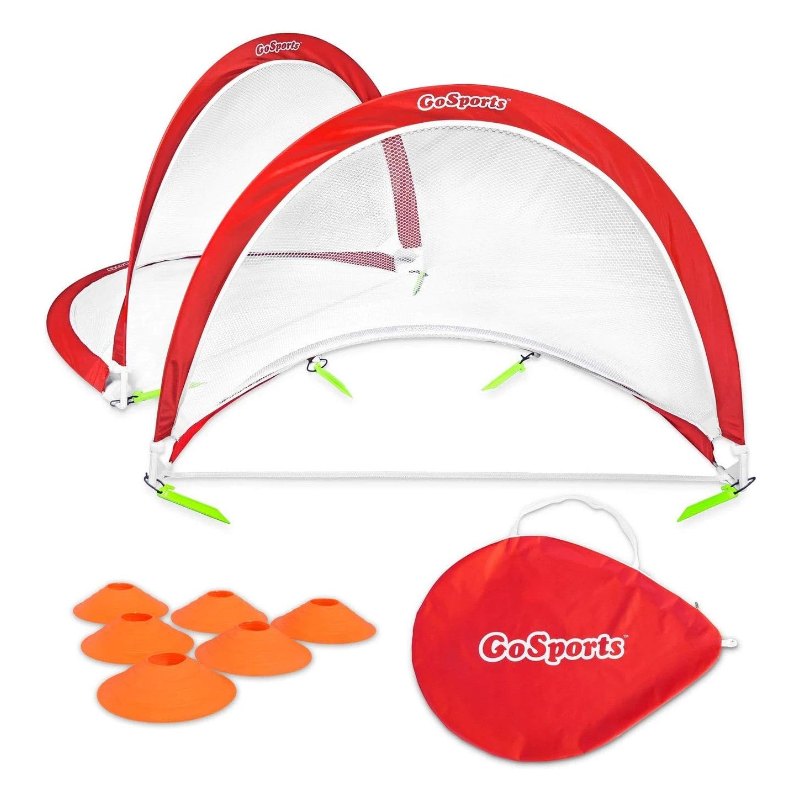
GoSports Portable Soccer Goals
You need this if: you want a sturdy backyard goal set that sets up in minutes and folds away.
It is our top pick in the pop-up and portable goals guide: two goals, quick setup and a carry bag, sized well for kids practising at home.
More choices: best pop-up soccer goals. We earn a commission when you buy through our links, at no extra cost to you.
Frequently asked questions
What size soccer goal for a 6 year old?
4 x 6 ft, the size used in U6 and U7 small-sided games.
What size soccer goal for a 10 year old?
6.5 x 18.5 ft for U10 7v7 games.
What size soccer goal for a 12 year old?
7 x 21 ft for U11 and U12 9v9 games.
When do kids play on full-size goals?
From U13, on 8 x 24 ft goals with 11v11 teams.
What size goal is best for the backyard?
Pop-up goals around 6 x 4 ft for young kids and 12 x 6 ft for older players.
Do soccer goals need to be anchored?
Yes. Larger goals must be staked or weighted so they cannot tip.