Updated November 23, 2026 · 15 min read
We earn a commission when you buy through our links, at no extra cost to you. How this works.
Volleyball rules explained
What a yellow card and a red card mean in volleyball
Volleyball cards look like soccer cards, but they work differently. A red card in volleyball doesn’t send a player off. It gives the other team a point. Here’s what every card and card combination means in high school, college and club volleyball, and the kit referees carry to show them.
Here is what volleyball red and yellow cards mean, when referees show them, and how a volleyball red card differs from a yellow card.
You’re watching your daughter’s match when the referee up on the stand holds up a red card, and suddenly the other team gets a point. Was it a player? The coach? Why didn’t anyone leave the court? Volleyball’s card system confuses a lot of parents and new players, because it doesn’t work like soccer, and it’s slightly different in high school, college and club play.
This guide explains the volleyball card system in plain English: what a yellow card means, what a red card means, what happens when the referee shows red and yellow together or one in each hand, and how delay sanctions work. We compare the rules for high school (NFHS), college (NCAA) and club and international play (USA Volleyball and FIVB), answer the questions parents and coaches ask most, and cover the referee cards and gear new officials need, including the Mikasa VK referee cards.
Quick answer: volleyball cards at a glance
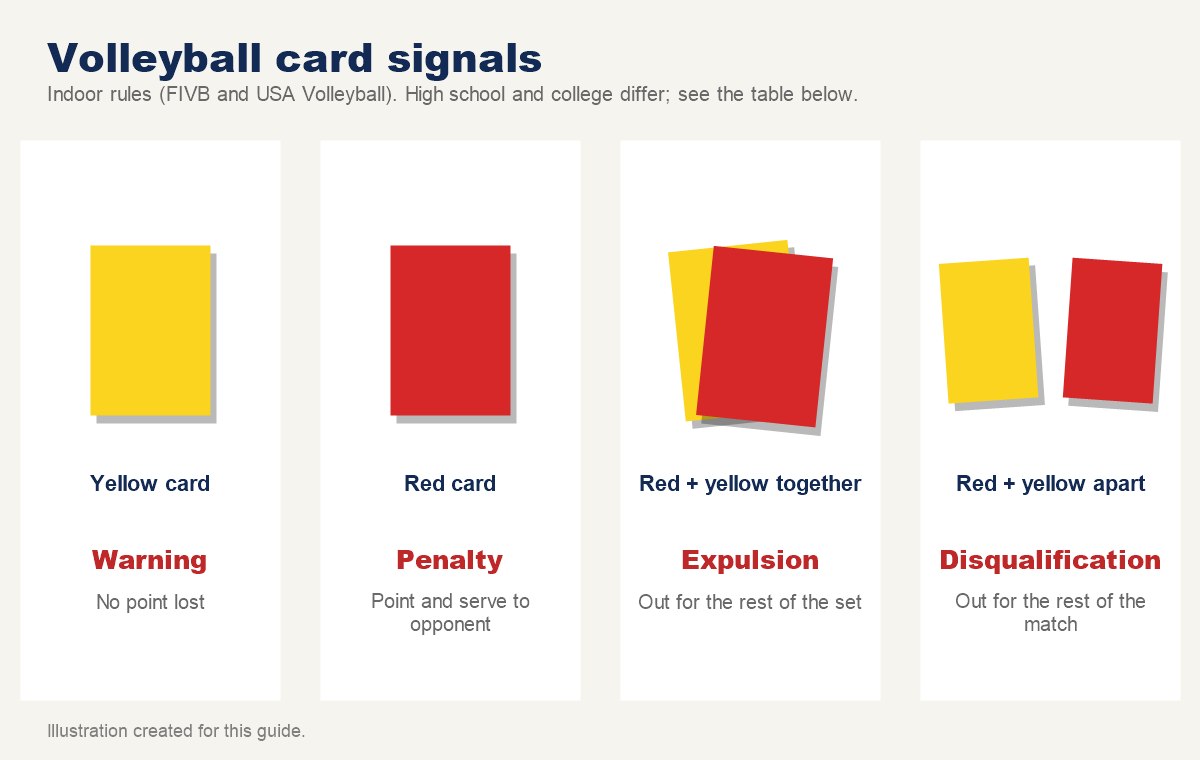
- Yellow cardA formal warning. No point is lost.
- Red cardA penalty. The other team gets a point (and the serve).
- Red and yellow togetherExpulsion in FIVB and club rules: out for the rest of the set
- Red and yellow apartDisqualification: out for the rest of the match
- Delay warning, delay penaltySeparate scale for slowing the game down
The short version: yellow means “that’s your warning,” red means “that cost you a point,” and the two cards together mean someone has to leave for a set or the whole match.
What does a yellow card mean in volleyball?
A yellow card is a formal warning for minor misconduct, such as arguing with a call, taunting through the net, or a bench that’s getting too loud. It’s recorded on the scoresheet, but the team does not lose a point.
Under international (FIVB) rules, the first referee usually starts with a verbal warning to the team through the game captain, then moves to a yellow card if the behavior continues. The referee can also skip straight to a yellow card, or to a bigger sanction, when the conduct is more serious.
In high school volleyball, a yellow card is also a warning. Since a 2020 rule change, a yellow card to the head coach for conduct on the bench no longer forces the head coach to sit down. A red card or a second yellow card does.
What does a red card mean in volleyball?
A red card is a penalty. The other team is awarded a point, and if they weren’t serving, they get the serve too. It’s given for rude conduct, repeated misconduct after a warning, or a first offense that’s serious enough to skip the yellow.
This is the biggest difference from soccer: a red card alone does not remove the player in volleyball. The player or coach stays in the match, but their team has given away a point. A second red card for the same person moves up the scale.
What does a red card mean for a coach?
The same thing: the other team gets a point. In high school, the head coach must also stay seated for the rest of the match after a red card. In FIVB rules, a coach who is expelled loses the right to coach for the rest of that set.
Red and yellow cards together, and apart
When the conduct is offensive or aggressive, or someone keeps misbehaving after a red card, the referee shows both cards:
- Red and yellow held together in one hand: expulsion (FIVB and USA Volleyball club rules). The player is substituted and sits in the penalty area for the rest of the set. An expelled coach can’t coach that set.
- Red and yellow held apart, one in each hand: disqualification. The player or coach must leave the competition area for the rest of the match.
High school (NFHS) rules don’t use the “together” expulsion. A red and yellow card shown apart means disqualification from the match, given for a third minor offense, a second serious offense, or one flagrant act. College rules follow a similar ladder.
Volleyball card rules by level
Rules are updated often, so treat this table as a guide and check the current rulebook for your league or state.
| Signal | High school (NFHS) | College (NCAA) | Club and international (USA Volleyball, FIVB) |
|---|---|---|---|
| Verbal warning | Often given first for minor issues | Often given first | Stage 1, given through the game captain |
| Yellow card | Warning, no point | Warning, no point | Warning, no point; recorded on the scoresheet |
| Red card | Point to opponent; head coach must sit | Point to opponent | Penalty: point and serve to opponent |
| Red + yellow together | Not used | Check current rules | Expulsion: out for the rest of the set |
| Red + yellow apart | Disqualification for the match | Disqualification for the match | Disqualification for the match |
A few more differences worth knowing:
- Carry-over: in high school, unsporting conduct cards carry over from set to set. In other rule sets, carry-over depends on whether the card went to an individual or the team. Ask the referee at the pre-match meeting if you’re unsure.
- Who shows cards: only the first referee (the one on the stand) issues conduct sanctions. The second referee and line judges report what they see.
- Beach volleyball uses the same basic FIVB sanction scale.
Check availability of Mikasa VK cards →
The sanction ladder, step by step
International rules group misconduct into levels and raise the sanction each time the same person repeats it in a match:
| Conduct | Example | Sanction |
|---|---|---|
| Minor misconduct | Arguing a call, a loud bench | Verbal warning, then a yellow card (no point) |
| Rude conduct (first time) | Disrespectful words or gestures | Red card: point and serve to opponent |
| Offensive conduct (first time) or rude conduct (second time) | Insulting words or gestures | Expulsion for the set |
| Aggression, offensive conduct (second time) or rude conduct (third time) | A physical attack or threat | Disqualification for the match |
Serious conduct can skip the steps. A referee doesn’t have to give a yellow before a red, or a red before a disqualification.
Delay sanctions: the other yellow and red
Volleyball also has a separate scale for delays, such as a slow substitution, an improper request after a warning, or taking too long to return to the court. Delay sanctions apply to the whole team:
- Delay warning: the first delay by a team in a match. No point is lost.
- Delay penalty: any later delay by that team in the same match. The opponent gets a point and the serve.
Referees signal delay sanctions differently from conduct sanctions, so a card shown against the wrist usually means a delay, not bad behavior. High school rules handle improper requests and delays in their own way, so check the NFHS rulebook.
Video: volleyball cards and referee signals explained
 ▶ Red card and yellow card in volleyball: sanctioning explained
A referee walks through warnings, red cards, expulsion and disqualification. The video loads from YouTube only when you press play.
 ▶ Volleyball Referee Signals Explained (For Beginners)
The hand signals referees use for faults, timeouts and substitutions, useful for new officials and parents.
The best volleyball referee cards and gear
If you’re a new official, a club coach who referees youth matches, or a school stocking its officials’ bag, these are the essentials we recommend. Mikasa is a long-time volleyball brand whose balls are used in international play.

Mikasa VK Volleyball Referee Cards, Red and Yellow
Perfect for: first referees at high school, club and college matches, and anyone building a referee kit.
- ColorsRed and yellow
- BrandMikasa
- Listing sizeSize 4
The VK is Mikasa’s red and yellow sanction card set. Retailers describe the cards as FIVB approved, and they’re the bright, rigid style that’s easy to see from the stand and across a big gym. Some sellers bundle a holder or arm band, so check what’s included on the listing before you order.
Good side:
- Bright red and yellow that read clearly from the back row and the bleachers
- Made by a volleyball brand, not a generic soccer set
- Small and light enough to keep in a shirt pocket on the stand
- Works for every level, from youth club to college
Keep in mind:
- Card size and accessories vary between listings, so read the details.
- A pair of cards does one job. You’ll still need a whistle, flags and a scoresheet.

Mikasa Volleyball Line Judge Flags
Perfect for: tournaments, school matches and clubs that use line judges.
- UseLine judge in, out and touch signals
- BrandMikasa
Line judges signal ball in, ball out, touched balls and foot faults with a flag. A matched set keeps your officiating crew looking consistent and makes calls easier for the first referee to see.
Good side: made for volleyball line judging; easy to pack with your cards. Keep in mind: check how many flags are in the listing for your crew size.

Mikasa V200W Volleyball
Perfect for: clubs and schools that want the same ball model used in international competition.
Officials don’t usually supply the ball, but the home team does, and many clubs choose the V200W for matches and serious practice. If you’re putting together a match-day bag for a club, it’s worth a look.
Volleyball referee kit checklist
Here’s what experienced officials keep in their bag for a tournament day:
| Item | Why you need it |
|---|---|
| Red and yellow cards | To show warnings and penalties |
| Whistle (plus a spare) | Start rallies and stop play |
| Line judge flags | For your line judges if the host doesn’t provide them |
| Coin | The coin toss before the match |
| Ball pressure gauge and pump | Check match balls before warm-ups |
| Measuring tape or net chain | Check the net height (see our volleyball net height finder) |
| Pencils and lineup sheets | Help the scorer and check lineups |
| Your association’s uniform | Shirt, pants and shoes your league requires |
| Water and snacks | Tournament days are long. See our volleyball tournament checklist. |
Add Mikasa referee cards to your kit →
How to show a card the right way
- Wait for the rally to end. Conduct sanctions are usually given at the next dead ball.
- Call the player or coach over (or speak through the game captain under FIVB rules) so everyone knows who the card is for.
- Hold the card up clearly so both benches, the scorer and the crowd can see it.
- Make sure the scorer records it with the player’s number, the set and the score.
- Stay calm and brief. The card does the talking. Don’t argue.
Real match situations: what card would the referee show?
These are common moments from youth, high school and club matches, and how referees usually handle them under the FIVB-style ladder. Every referee uses judgment, and your level’s rules may differ.
| Situation | Likely sanction | What happens next |
|---|---|---|
| A player throws their hands up and complains after a net call | Verbal warning through the captain, or a yellow card | Play continues; no point lost |
| A player keeps arguing after a yellow card | Red card | Opponent gets a point and the serve |
| A player taunts an opponent under the net after a kill | Yellow card, or red if it’s aimed and repeated | Red card costs a point |
| A coach leaves the coaching area to shout at the referee | Yellow, then red | In high school, a red means the coach must sit |
| A player swears at an official | Expulsion (red and yellow together) or disqualification | The player leaves for the set or the match |
| A player kicks the ball into the stands in anger | Red card or more, depending on intent | Point to opponent; repeat offenses climb the ladder |
| A player pushes or threatens an opponent | Disqualification (red and yellow apart) | The player leaves the competition area for the match |
| A team is slow to substitute after a delay warning | Delay penalty | Opponent gets a point and the serve |
Notice that most problems stop at the verbal warning or the yellow. Referees would much rather manage a match with a quick word than with cards, and a good captain helps calm things down before it reaches a red.
What to do when a card is shown
If you’re the player
- Stay calm and let the captain speak for you.
- Don’t argue the card. Arguing is the fastest way to turn a yellow into a red.
- Remember the card stays on the scoresheet, so the next offense will be sanctioned more strictly.
If you’re the coach
- Ask the referee calmly, through the proper channel, which rule was applied if you’re unsure.
- Talk to the player at the next timeout, not across the court.
- In high school, sit down right away after a red card or second yellow, or you risk a further sanction.
If you’re the scorer
- Record the sanction in the sanctions box with the type, the person, the set and the score.
- Award the point on the scoresheet when a red card or delay penalty is given.
- Tell the first referee right away if the same person is about to receive a higher sanction, so it’s applied correctly.
Referee signals you’ll see with the cards
Cards sit alongside a full set of hand signals. Knowing a few helps you follow what’s happening:
- Point to the serving side: the referee extends an arm toward the team that will serve next. After a red card, that’s the team that got the point.
- Timeout: the hands form a “T.”
- Substitution: the forearms roll around each other.
- Ball in: the arm points to the floor on that side.
- Ball out: both forearms raised, palms facing the body.
- Touched ball (off the block): one hand brushes the fingertips of the other raised hand.
- Net fault: the referee touches the net on the side of the team at fault.
- Double hit: two fingers raised.
Line judges use flags for in, out and touches, which is why a set of line judge flags belongs in a club’s officiating bag. The second video above shows each signal.
Tips for players, coaches and parents
- Players: only the captain should talk to the referee about calls. A respectful question is fine; arguing is a quick yellow.
- Coaches: know your level’s rules on standing and the coaching box, and remind your bench that their behavior counts against the team.
- Parents: referees can ask a tournament director to remove spectators. A red card can’t be given to a parent, but a team can lose points for a bench that won’t settle down.
- New referees: use the verbal warning well. Most problems stop there.
Is a card set worth buying?
If you referee, yes. Hosts don’t always supply cards, and a borrowed set may be missing a color. Cards are small, cheap and last for years. A volleyball-specific set like the Mikasa VK also looks professional on the stand, which matters when you’re new and the coaches are watching.
Coaches can benefit too. Having a set in practice is a simple way to teach players what each card means before their first big tournament. Cards also make a useful gift for a club volunteer who’s starting to referee; see more ideas in our volleyball gift guide.
Volleyball red and yellow cards: frequently asked questions
Does a red card in volleyball mean you’re out?
No. A red card alone gives the other team a point. A player is only removed when the referee shows red and yellow together (out for the set, in FIVB and club rules) or apart (out for the match).
Can you get a yellow card in volleyball?
Yes. A yellow card is a formal warning for minor misconduct, like arguing or taunting. It doesn’t cost a point.
How many yellow cards before a red card?
There’s no set number. After a warning, the next misconduct by the same person moves up the scale. Serious conduct can earn a red card right away.
What happens if a coach gets a red card in high school volleyball?
The other team gets a point, and the head coach must remain seated for the rest of the match. A yellow card to the head coach no longer requires sitting.
Do cards carry over between sets?
In high school volleyball, unsporting conduct cards carry over from set to set. Other rule sets differ, so check your league’s current rules.
Are volleyball referee cards the same as soccer cards?
They’re the same red and yellow colors, but volleyball uses them differently. Any clearly colored set works, though many referees prefer volleyball-specific cards such as the Mikasa VK set.
Who shows cards in a volleyball match?
The first referee, who stands on the referee stand at the net. Other officials report what they see.
Final verdict
Volleyball’s card system is simpler than it looks: yellow is a warning, red is a point to the other team, and red with yellow means someone leaves for the set or the match. If you referee or coach, keep a proper set of cards in your bag. The Mikasa VK referee cards are a volleyball-specific choice that reads clearly from the stand. Add Mikasa line judge flags if your crew needs them.
See the Mikasa VK Referee Cards on Amazon →
Related volleyball guides
 Volleyball Tournament Checklist (Free Printable): what to pack. Read Guide →
 Best Volleyball Knee Pads for girls, teens and adults. Read Guide →
 Best Volleyball Shoes for women, girls and men. Read Guide →
 Best Gifts for Volleyball Players: ideas for girls, teens and coaches. Read Guide →
 Best Portable Volleyball Nets for backyard, beach and gym. Read Guide →
 Officiating baseball too? Best Umpire Gear for baseball and softball. Read Guide →
See every Mikasa ball and accessory on our Mikasa brand page, and check net heights by age with the net height finder.
How we wrote this guide
We based the rules on the FIVB Official Volleyball Rules sanction scale and published high school and college rule interpretations, and checked product details against each listing and retailer descriptions. Volleyball rules change often, so confirm with your league’s current rulebook. We do not list prices or ratings because they change; check the current price on Amazon. How we pick products.
We update this page on volleyball red and yellow cards as new gear and rules come out.
For official rules and equipment standards, see USA Volleyball.

We research sports gear for players, coaches and sports parents. We compare specs, check maker information and owner feedback, and name one clear pick for each kind of player. How we pick · Affiliate disclosure