Updated November 23, 2026 · 13 min read
We earn a commission when you buy through our links, at no extra cost to you. How this works.
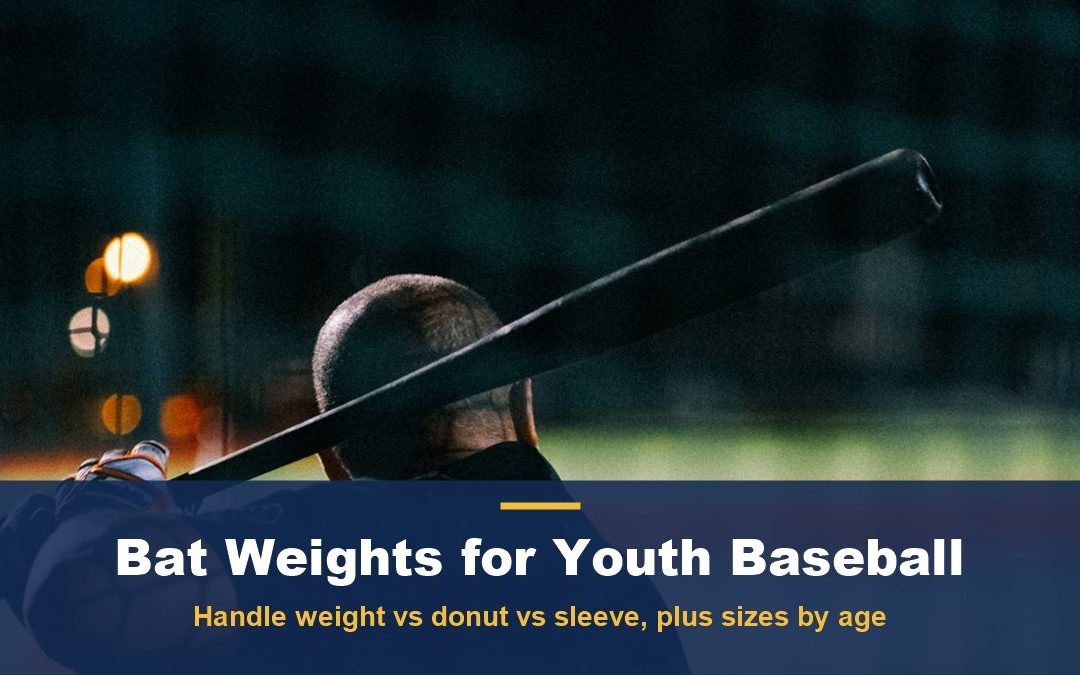
Bat weights for youth baseball and softball
Build bat speed and strong hands without wrecking the swing
Most bat weights only work in the on-deck circle. The Hitting Jack-It is different: it sits on the handle, just above the hands, so hitters can use it off a tee, in soft toss and even in live batting practice. Here is how it compares with donuts and sleeves, which weight fits which age, and how to use one safely.
Walk past any youth baseball dugout and you’ll see a kid swinging a bat with a heavy ring on it. Parents ask the same questions every season: Does a bat weight actually help? Which weight should my 9-year-old use? Is it safe? And what’s the difference between a donut, a sleeve and a handle weight like the Hitting Jack-It?
This guide answers all of it. We cover the three types of bat weights, what coaches and research say about donuts, why a handle weight works differently, a size chart by age, a 15-minute practice routine and the common mistakes that turn a training tool into a bad habit. We also break down the four Hitting Jack-It listings our readers ask about, from the single weights to the full 9, 12, 16 and 21 oz set.
Quick answer: which bat weight should you buy?
- Best complete setHitting Jack-It set, 9, 12, 16 and 21 oz
- Best for a growing youth hitterWeighted bat jacket set, 9, 12 and 16 oz
- Best to start with one weightSingle Hitting Jack-It (9 oz for ages 8 and up)
- Best for on-deck onlyA light donut, used for a few swings, then off
- Want one weight that works from age 8 to high school? Get the 4-weight Hitting Jack-It set. You move up a size as your hitter grows.
- Buying for a 9 to 14-year-old? The 3-weight set (9, 12 and 16 oz) covers the years that matter most.
- Just want to try it? Start with a single Hitting Jack-It in the lightest size for the age.
The 3 types of bat weights
Every bat weight adds mass to the bat. Where that mass sits changes everything: how the bat feels, whether the hitter can still hit a ball, and how much it changes the swing.
1. Donut (ring) weights
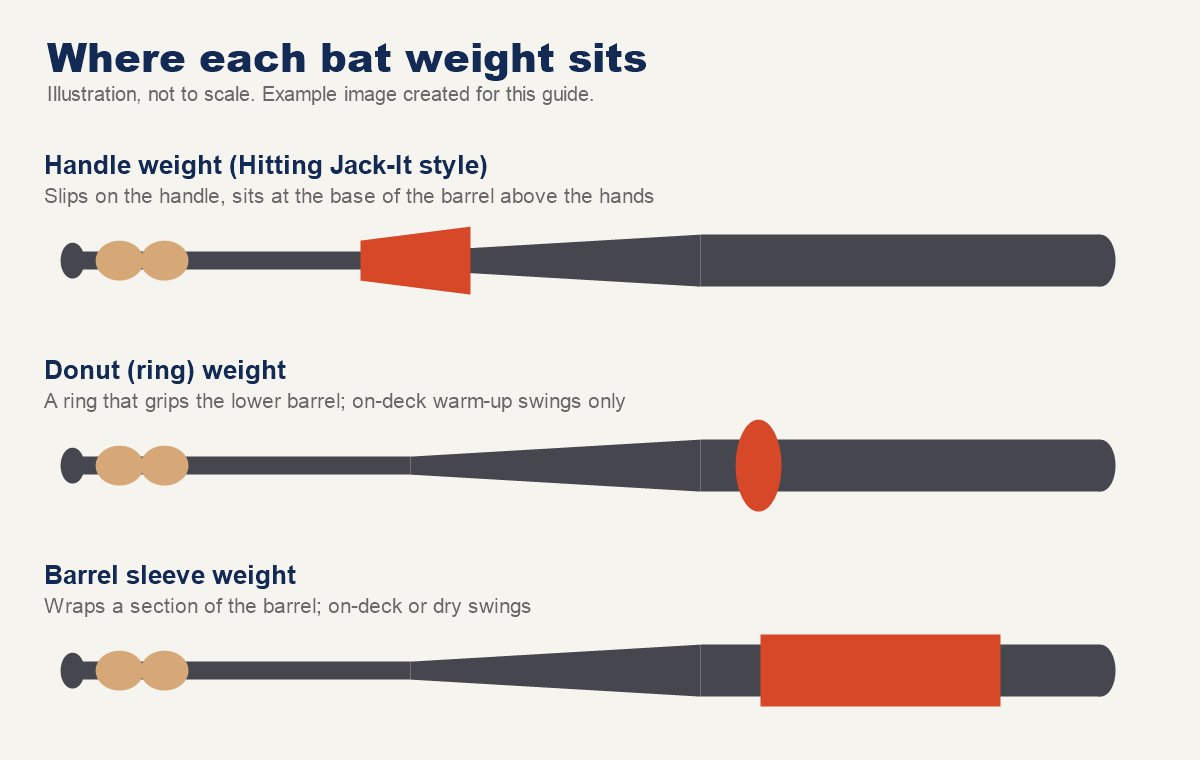
The classic on-deck weight. A heavy ring, usually rubber-coated, slides onto the bat and grips the lower barrel. Because the weight sits far from the hands, the bat feels much heavier than it is. Donuts are for warm-up swings only. You should never hit a ball with one on, since the ring can fly off or crack a bat.
2. Barrel sleeve weights
A sleeve wraps a section of the barrel, often with hook-and-loop or a rubber shell. The weight is spread over more of the barrel than a donut, but it still covers the hitting surface, so sleeves are also on-deck and dry-swing tools. Some users find sleeves slide during hard swings.
3. Handle weights (Hitting Jack-It)
The Hitting Jack-It is a cone-shaped, rubber-coated carbon steel weight with an open side. It slips onto the handle and sits snugly at the bottom of the barrel, just above the batter’s hands. The maker says it works with all baseball and softball bats, and because the barrel stays clear, players can hit live pitching, soft toss and tee work with it on.
Weight close to the hands changes the swing far less than weight at the end of the barrel. That’s the whole idea: the hitter feels resistance and works the hands and forearms, but the swing path stays close to normal.
Do bat weights actually work?
It depends on how you use them. Here’s an honest summary of what coaches and research say:
- Donuts on deck don’t make the next swing faster. Several studies and many hitting coaches report that swinging a donut right before an at-bat doesn’t increase bat speed in that at-bat, and some found slightly slower swings. The bat just feels lighter, which can help confidence but not speed.
- Heavy weights can change mechanics. A lot of weight at the end of the barrel makes young hitters drop the barrel, cast the hands or lean back. Watch the swing whenever you add weight.
- Training over weeks is different from warming up. Overload and underload training (swinging slightly heavier and lighter bats in planned sets) is widely used to build bat speed over time. The key is a modest extra weight and good swings, not a heavy weight and ugly ones.
- Handle weights are a middle ground. With the weight above the hands, the change to bat balance is smaller, so a hitter can do real reps and still hit a ball. The maker says the Hitting Jack-It helps keep the hands working properly, encourages a short, compact swing and strengthens the hands and forearms. Those are the maker’s claims, but the design is sound for practice use.
Bottom line: a light weight, used for planned practice reps and always followed by normal swings, is a useful tool. A heavy donut swung hard before every at-bat is mostly a habit.
Check the 3-Weight Bat Jacket Set on Amazon →
Bat weight size chart by age
The Hitting Jack-It maker lists a recommended starting age for each size. Use it as a ceiling, not a target: start with the lightest weight that your hitter can swing with good form.
| Weight | Maker’s recommended age | Main goal (maker) | Our tip |
|---|---|---|---|
| 5 oz (softball version) | Younger softball players | Bat speed | Good first weight for young fastpitch hitters |
| 9 oz | 8 and up | Bat speed | The starting point for most youth hitters |
| 12 oz | 12 and up | Strength | For middle schoolers with a solid swing |
| 16 oz | 15 and up | Power | High school hitters, short sets only |
| 21 oz | 15 and up | On-deck size | Older, strong hitters; few swings at a time |
Under 8? Most young kids are still learning a basic swing. Skip the weight and spend the time on tee work and soft toss instead. If they want to join in, use the lightest weight for a handful of swings under supervision.
How do I know the weight is too heavy? If the barrel drops below the hands, the front shoulder flies open, the swing gets long or the hitter grunts to get the bat through the zone, go lighter. Swing quality beats weight every time.
The best bat weights we recommend
All four listings below are the Hitting Jack-It style handle weight, sold by Markwort, a long-time baseball and softball team supplier. They differ in how many weights you get.

Hitting Jack-It Weighted Bat Jacket Set (9, 12, 16 and 21 oz)
Perfect for: families with several ages, high school hitters and coaches who want one set for the whole team.
- Weights9, 12, 16 and 21 oz
- TypeHandle weight, slips on above the hands
- FitsBaseball and softball bats (maker)
This is the full progression in one box. A hitter can start at 9 oz around age 8 and move up as they grow, and an older player can use the 16 oz for strength work and the 21 oz as an on-deck weight. For a coach, one set covers the youngest player to the strongest on the roster.
Good side:
- Every size in the range, so it lasts for years
- Can be used for tee work, soft toss and live batting practice (maker)
- Weight sits near the hands, so the swing stays close to normal
- Rubber-coated steel, easy to slip on and off
Keep in mind:
- The 16 and 21 oz weights are for older, strong hitters only.
- You may pay for sizes a young player won’t use for years.

Weighted Bat Jacket Set (9, 12 and 16 oz)
Perfect for: parents of a player around 8 to 15 who want a weight to grow into.
- Weights9, 12 and 16 oz
- TypeHandle weight, slips on above the hands
- FitsBaseball and softball bats (maker)
The three most useful sizes without the heavy 21 oz on-deck weight. The 9 oz covers the Little League years, the 12 oz fits middle school and the 16 oz is there when your hitter reaches high school.
Good side:
- Covers the key youth and middle school years
- Skips the 21 oz weight most young hitters don’t need
- Same handle-weight design for practice with a ball
Keep in mind:
- No 21 oz on-deck weight for older power hitters.
- Young softball players may want the lighter 5 oz softball version instead.

Hitting Jack-It, Single Weight
Perfect for: trying a handle weight before buying a set, or replacing one size.
- WeightsSingle weight; choose the size on the listing
- TypeHandle weight, slips on above the hands
- FitsBaseball and softball bats (maker)
Amazon has two single Hitting Jack-It listings. Open them, check the weights and colors on offer, and pick the size from the age chart above. For most youth hitters, that’s the 9 oz.
Good side:
- Lowest cost way to try the handle-weight idea
- Easy to toss in a bat bag
- Good backup if a set piece goes missing
Keep in mind:
- A growing player will need the next size later.
- Check the weight carefully before you order, since sizes look similar in photos.
Video: the Hitting Jack-It in action
 ▶ Hitting Jack-It Training Demonstration
Players using the Hitting Jack-It for tee work, soft toss and live batting practice. The video loads from YouTube only when you press play.
 ▶ How to put on the Hitting Jack-It
A short clip showing how the weight slips onto the handle and seats above the hands.
Handle weight vs donut vs sleeve: comparison
| Type | Where it sits | Hit a ball with it? | Best use | Main risk |
|---|---|---|---|---|
| Hitting Jack-It handle weight | Handle, above the hands | Yes, per the maker (tee, soft toss, live BP) | Practice reps that build hands and forearms | Too heavy a size for the age |
| Donut (ring) | Lower barrel | No | A few on-deck warm-up swings | Casting and a long swing; no bat speed gain in the at-bat |
| Barrel sleeve | Section of the barrel | No | On-deck or dry swings | Can slide; changes bat balance |
| Weighted training bat | Whole bat | Depends on the model | Planned overload sets | Fatigue if overused |
How to use a bat weight: a 15-minute youth routine
Use this two or three times a week in the off-season or before practice. Rest at least a day between sessions, and stop if anything hurts.
- Warm up (3 minutes): arm circles, light jogging and 10 easy dry swings with a normal bat.
- Tee work with the weight (4 minutes): slip on the lightest size for the age. Take 10 to 15 swings off a batting tee, focused on short, quick hands and hitting line drives.
- Tee work without the weight (3 minutes): take the weight off and take the same number of swings. The bat should feel quick. This contrast set is the most important part.
- Soft toss with the weight (3 minutes): 10 swings into a hitting net, then 10 more without it.
- Finish without weight (2 minutes): always end with normal swings so the last feel is game speed.
Total weighted swings: about 25 to 30. For kids under 12, cut that in half. Quality swings matter more than the count.
Live batting practice
The maker says the Hitting Jack-It can be used in live batting practice. Start with front toss or slow machine pitch, then build up. Keep it to one round with the weight and one without.
On deck
If your hitter likes a heavier feel on deck, use a few slow swings with the weight, then take it off and take two or three normal swings at game speed. Some leagues limit warm-up devices or on-deck activity for young divisions, so check your league’s rules.
Start with one Hitting Jack-It on Amazon →
Common bat weight mistakes
| Mistake | What to do instead |
|---|---|
| Using the heaviest weight in the set right away | Start light. Move up only when 20 swings look the same as without the weight. |
| Ending practice with weighted swings | Always finish with normal swings at game speed. |
| Hitting a ball with a donut on the bat | Never. Use a handle weight made for practice with a ball. |
| Swinging near teammates | Clear a full circle around the hitter. Weighted bats travel farther if they slip. |
| Too many reps for young kids | Short sets, two or three times a week, with rest days. |
| Ignoring the swing | Film a few swings with and without the weight. If they look different, go lighter. |
Your questions, answered honestly
Is it good for kids?
Yes, from about age 8 with the 9 oz weight, in short sets and with an adult watching. Younger kids get more from basic tee work.
Does it work for softball?
The maker says it works with all baseball and softball bats. A lighter 5 oz softball version is sold for younger fastpitch players.
Will it fit my bat?
The open-sided design slips onto the handle and seats at the bottom of the barrel. The maker says it works with all baseball and softball bats, including youth and adult sizes.
Can it damage my bat?
The weight is rubber-coated, and it sits on the handle, not the hitting surface. Check your bat maker’s warranty rules on training devices if you have an expensive composite bat.
Does it replace a weighted training bat?
No, they do different jobs. A handle weight is quick to add to the bat your player already uses. A weighted training bat is a separate bat for planned overload sets. Many hitters use both.
Is it worth it over a cheap donut?
If you want to hit balls with weight on the bat, yes, because a donut can’t do that safely. If you only want a few on-deck swings, a donut is enough.
Who should buy a Hitting Jack-It
- Youth hitters 8 and up who already have a basic swing and want stronger hands.
- Middle and high school players doing off-season strength work.
- Softball players who want weighted reps with a ball.
- Coaches who want a whole-team tool for tee and soft toss stations.
Who should skip it
- Tee ball players and young beginners still learning to make contact.
- Hitters with sore elbows or shoulders; see a doctor or trainer first.
- Anyone who only wants an on-deck feel; a light donut does that.
Coaching softball? See our softball hitting training aids guide for weighted softballs, a one-hand training bat and the Markwort PowerSwing bat weight.
Got questions?
Frequently asked questions
What weight bat donut should a 9-year-old use?
Go light. For a handle weight like the Hitting Jack-It, the maker recommends the 9 oz from age 8. Watch the swing; if the barrel drops or the swing gets long, the weight is too heavy.
Do bat weights increase bat speed?
Swinging a donut right before an at-bat doesn’t increase bat speed in that at-bat. Planned training with modest extra weight, followed by normal swings, is a common way to build bat speed over weeks.
Can you hit with a bat weight on?
Not with a donut or barrel sleeve. The Hitting Jack-It sits on the handle, and the maker says it can be used for tee work, soft toss and live batting practice.
What’s the difference between a bat sleeve and a donut?
A donut is a ring that grips the lower barrel. A sleeve wraps a longer section of the barrel. Both are for warm-up swings, not hitting balls.
Are bat weights legal in Little League?
Rules on warm-up devices and on-deck activity vary by league and division. Ask your league before using one at games.
How often should kids use a bat weight?
Two or three short sessions a week, about 15 minutes, with rest days in between.
Final verdict: is a Hitting Jack-It worth it?
For a youth hitter aged 8 or older who practices at home, yes. Because the weight sits above the hands, it does something a donut can’t: it lets your player hit real balls with extra weight, then feel quick when it comes off. Pick the 4-weight set if you want every size from youth to high school, the 3-weight set for the youth and middle school years, or a single weight to try it out. Keep the weight light, the sets short and always finish with normal swings.
See the 4-Weight Hitting Jack-It Set on Amazon →
See the 3-Weight Bat Jacket Set on Amazon →
Related baseball training guides
 Best Baseball Swing Trainers: tee attachments and kids picks. Read Guide →
 Best Baseball Bats by Age: 8, 10, 12 year olds and high school. Read Guide →
 Best Batting Tees: picks for toddlers to high school hitters. Read Guide →
 Best Baseball Hitting Nets for backyard and garage practice. Read Guide →
 Best Batting Gloves: youth and adult picks plus size chart. Read Guide →
 Softball Bat Size Chart: fastpitch bat size by age and height. Read Guide →
For more team and training gear, see the Markwort brand page.
How we chose
We researched how each type of bat weight is used, what hitting coaches and published research say about donuts and weighted swings, and the maker’s own instructions and age guide for the Hitting Jack-It. Product details come from the maker’s description and each listing. We do not list prices or ratings because they change often; check the current price on Amazon. How we pick products.

We research sports gear for players, coaches and sports parents. We compare specs, check maker information and owner feedback, and name one clear pick for each kind of player. How we pick · Affiliate disclosure